Laguna de los Cóndores Trek
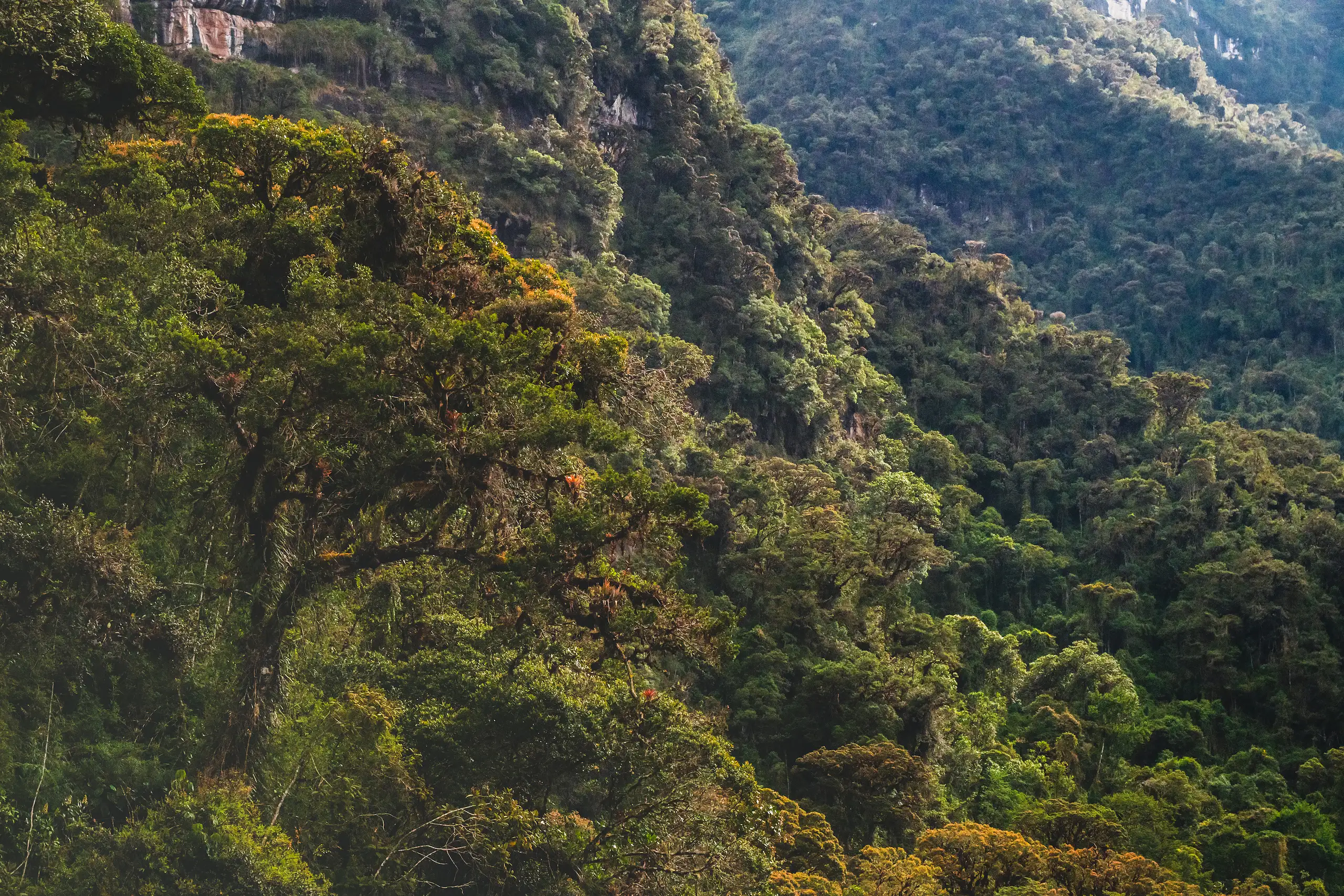
Four days to a black lake ringed by cloud forest, where Chachapoya mausoleums still stand painted on a cliff ledge a hundred meters above the water. It is the hardest trek in the Chachapoyas region, and between 150 and 200 people reach it in a year.
The Route
Campesinos from Leymebamba came across this lake in the 1950s looking for new pasture, and took its deep black color for petroleum before working out it was water. In 1996 ranch hands found tombs on a cliff platform a hundred meters above the south shore; the emergency operation that followed carried 219 mummies and more than 2,400 artifacts out to Leymebamba by horse. The mausoleums are still there, four of the six holding white, red and yellow pigment, two carrying the zigzag friezes that mark Chachapoya funerary building, along with painted serpents and condors — the birds the first arrivals saw here, and the reason for the name.
Getting there is the price of admission. The approach is 23 kilometers from Dos de Mayo, above Leymebamba: a steady climb to a 3,628-meter pass, then a sharp drop into the basin through mud that gets worse the closer you get. Nine to eleven hours walking, around eight on horseback, and we are direct with people about riding it. What you get for the day is a lodge on the shore of a lake nobody else is visiting, two days to paddle out to the mausoleums and climb to the viewpoint above Quindecocha, and 360 degrees of virgin cloud forest in a valley now protected as the 46,000-hectare Chilchos Private Conservation Area. Four hundred people start the Inca Trail every day; this lake sees fewer than two hundred in a year.
Trip Highlights
- Chachapoya cliff mausoleums, still painted, reached by boat and ladder
- A lake fewer than 200 people reach in a year
- 360 degrees of virgin cloud forest in the Chilchos conservation area
- The viewpoint above Quindecocha, over the full length of the lake
4D / 3N
3,628 m / 11,903 ft
Advanced
May to October, best June to August
Non-technical, but sustained: 23 km and 1,652 m of ascent in a day, on steep trail that holds deep mud
Elevation Profile
Distance
23.14 km
Total Ascent
+1,652 m
Trailhead
2,299 m
High Point
3,628 m
Itinerary
We leave Chachapoyas early for the two-and-a-half-hour drive to Leymebamba and carry on up to Dos de Mayo, the village directly above town where the trail starts at 2,299 meters. This is the hardest day of the trek and one of the hardest days of walking in northern Peru: 23 kilometers, climbing steadily for the first 17 to a high point of 3,628 meters, then dropping 640 meters to the lake in under three. Expect 9 to 11 hours on foot, or around 8 in the saddle, and expect deep mud — especially in the final three hours down through the cloud forest. The arrieros and pack horses carry the duffels; you carry a daypack. We arrive at the basecamp lodge on the shore of Laguna de los Cóndores in the late afternoon.
- Distance
- 23.1 km
- Ascent
- 1,652 m
- Descent
- 961 m
MealsBreakfast, trail lunch, dinner
A short day, and the reason most people come. We paddle about thirty minutes across the lake, then climb roughly forty-five minutes up wooden ladders and muddy path to the ledge where the mausoleums stand beneath a limestone overhang, a hundred meters above the south shore. Four of the six structures still carry white, red and yellow pigment, and two are marked with the zigzag friezes typical of Chachapoya funerary building. What remains on the ledge are a few skulls, wood carvings and scraps of textile, along with painted serpents, condors and figures on the walls. The 219 mummies taken from here in 1997 now live in the museum in Leymebamba. We paddle back for lunch and spend the afternoon at the lodge.
MealsBreakfast, lunch, dinner
Today we climb to Quindecocha, the lake that sits above Laguna de los Cóndores. The trail passes a large landslide that has stripped the slope back and opened the view, and higher up it comes out at a viewpoint that takes in the full length of the lake below — cliff walls draped in vegetation, palms, and cloud forest in every direction. It is a far easier day than the approach, and the light is usually best early. Back at the lodge there is time to dry kit on the lines, fish for trout with the guides, or do nothing at all.
MealsBreakfast, lunch, dinner
The same 23 kilometers in reverse: 640 meters of climbing straight out of the lake basin to regain the 3,628-meter pass, then the long descent to Dos de Mayo and Leymebamba. Another 9 to 11 hours on foot, or around 8 on horseback. If time allows we stop at the Museo Leymebamba, where the 219 mummies and more than 2,400 artifacts recovered from the lake are kept in a climate-controlled room you can look into through two large windows. Private transport returns you to Chachapoyas in the evening.
- Distance
- 23.1 km
- Ascent
- 961 m
- Descent
- 1,652 m
MealsBreakfast, trail lunch
What's Included
Included
- Private transport from Chachapoyas to Leymebamba and back
- Local guide from Leymebamba (required by the community)
- Cook and all meals on the trek
- Arriero and pack horses for duffels and group loads
- Three nights at the basecamp lodge, bedding provided
- Boat crossing of the lake to the mausoleums
- Chilchos Private Conservation Area fee
Not Included
- International and domestic flights
- Accommodation in Chachapoyas before and after the trek
- Riding horse for the approach and return (on request, extra cost)
- Meals in Chachapoyas and Leymebamba
- Museo Leymebamba entrance
- Personal gear and preferred snacks
- Travel insurance
- Gratuities
Packing List
Two things decide what you pack here: mud and water. The trail holds mud for most of its length and the cloud forest is wet even in the dry months, so the single most useful thing you can carry is a dry set of clothes sealed in a bag for the evenings. The lodge provides bunks and bedding, so no sleeping bag is needed. There is no shower — a water spout for rinsing off, and lines for drying kit.
Documents & Money
- Passport
- Cash in Peruvian soles
- Travel insurance documents
Clothing
- Two or three sets of trail clothes — you will not dry everything overnight
- One dry set kept sealed for the evenings
- Waterproof rain jacket, and rain trousers if you own them
- Fleece or light insulating mid-layer
- Insulated jacket for the pass and for evenings at the lodge
- Warm hat and sun hat or cap
- Trekking socks, more pairs than you think
Footwear
- Rubber boots are what the guides wear and what the mud rewards
- Waterproof hiking boots with ankle support, as the alternative
- Gaiters
- Camp shoes or sandals for the lodge
Gear & Equipment
- Daypack, 25–35 L, with a rain cover and a liner bag
- Dry bags — the most valuable item on this list
- Trekking poles, strongly recommended for the descent
- Headlamp with spare batteries
- 1–2 L water bottles or bladder (safe drinking water is provided)
- Quick-dry towel
Health & Hygiene
- Personal medications and a copy of your prescriptions
- Blister care — moleskin, tape, or your preferred fix
- Insect repellent
- Sunscreen, lip balm and sunglasses
- Personal first-aid kit
- Hand sanitizer and biodegradable soap
Electronics & Other
- Power bank — there is no charging at the lodge
- Camera, with a dry bag or waterproof case for the boat
- Favorite trail snacks (meals and basic snacks are provided)
- Book or eReader for the afternoons
Don't Have Everything?
You do not need to own all of this. Tell us what you already have when you book and we will advise on what is worth buying, what to leave behind, and what we can source in Chachapoyas before you leave.
Frequently Asked Questions
Ready to plan this trek?
Every departure is arranged privately. Send us your objective, experience, and travel window.